


Overview
Demo package: Service trenches and drainage — not tied to a real contract, KPI or client name. Simulated dossier to illustrate BTH E&C project-page structure (scope, execution, HSE/QA and handover).
Discipline: Infrastructure / civil
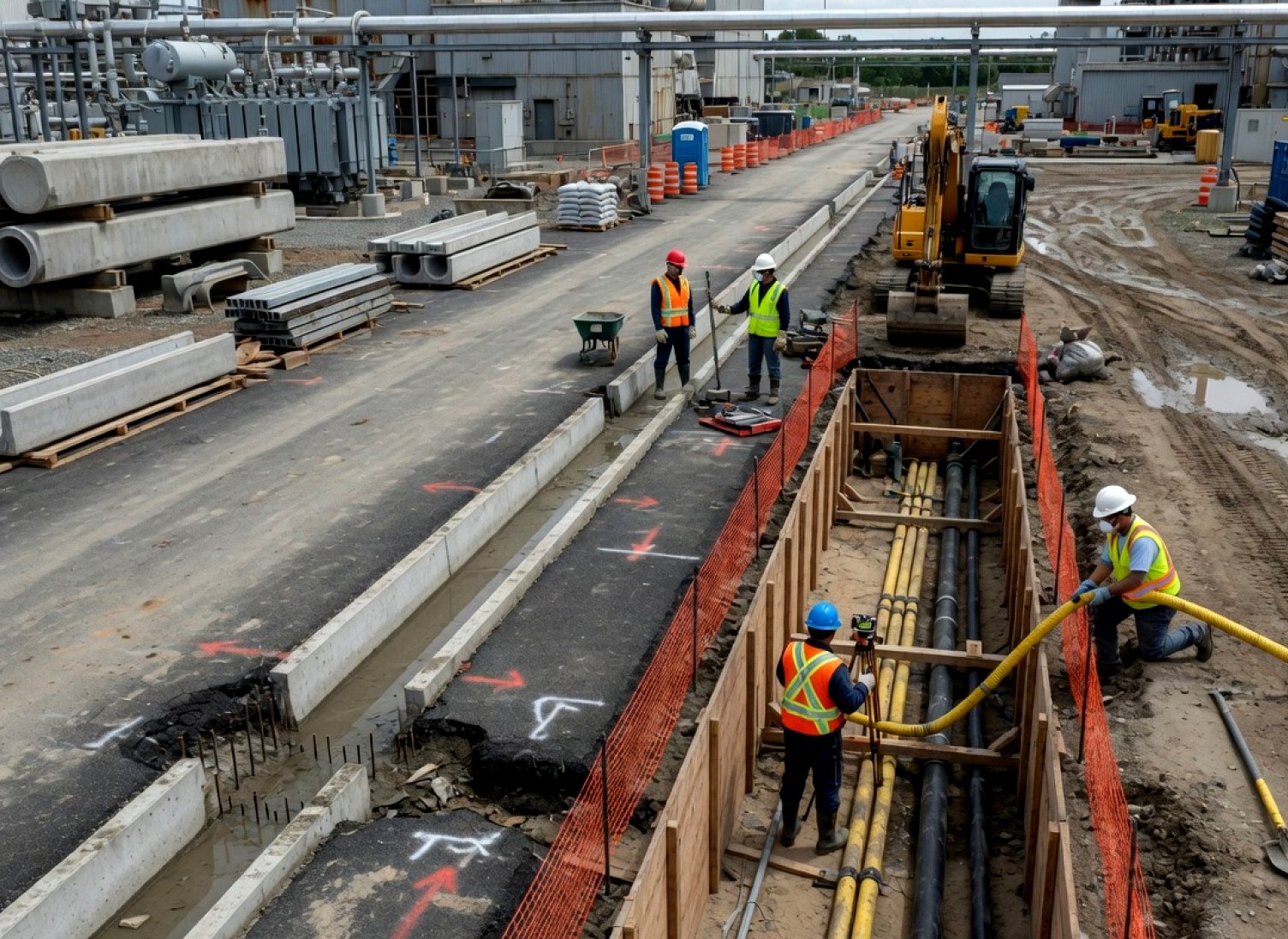
Scope of work (simulated)
Demo service trench, covers, drainage fall and plant infrastructure tie-in.
Execution sequence
- Route survey & fall
- Excavate / form / rebar
- Cast trench
- Covers & seals
- Flow test & handover
Between steps, keep punch lists explicit and do not silently expand scope while working in a live plant.
Site HSE
Barricade excavations; trench support; wet-area PPE; no standing water slip risks.
Start-of-shift toolbox, area PPE, and stop-work authority when hazards appear. Hot-work/lift/excavation permits (if any) must remain valid for the whole shift.
QA/QC and handover dossier
Fall survey minutes, rebar photos before pour, cover checklist.
- Annotated site photos
- Package acceptance checklist
- Illustrative as-built for assumed quantities
- Closed punch list
Important note
All figures, plant names and measurements here are simulated. Do not use this page as proof of delivery for the named package. Real BTH projects are listed separately without the demo badge.
Coordination with operations
Before mobilisation, lock shutdown/isolation windows, exclusion zones and the operations counterpart. During works, update the punch list daily (or per shift) and do not expand beyond the approved method statement. At stage end: clean the area, collect tools, and temporary-handover if the machine must run again mid-package.
Common risks (simulated)
- Missing interface survey causing tray / pipe / structure clashes
- Incomplete LOTO points or wrong circuit labels
- Materials without incoming certificates
- As-built not updated after re-routes
These risks are training prompts — not descriptions of a real client incident.
Demo content